Showing posts with label Covalent. Show all posts

Sunday, 25 May 2014

1.45 explain how the uses of diamond and graphite depend on their structures, limited to graphite as a lubricant and diamond in cutting.

Covalent Structures

Diamond
Properties:
  • Very high melting point (many strong covalent bonds)
  • Very hard (covalent bonds are hard to break)
  • Does not conduct electricity (all of the outer/valence electrons are used to form bonds so there are no delocalised electrons to conduct electricity)
Uses:
  1. Cutting tools (hard and abrasive)
Graphite
Properties:
  • Very high melting point (many strong covalent bonds)
  • Soft and slippery (forces of attraction between the layers are weak so they can slide over each other)
  • Conducts electricity (only 3 of the 4 valence electrons are used up. This means that there is 1 delocalised electron per carbon atom to conduct electricity through the structure.)
Uses:
  1. Lubricant
  2. Electrodes for electrolysis

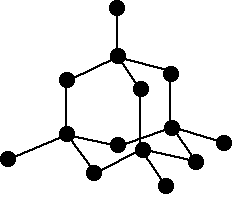
1.44 draw diagrams representing the positions of the atoms in diamond and graphite

Covalent Structures

These are two images of a covalent structure. 
Diamond has a 3D lattice with 4 carbon-carbon bonds
Graphite has a 3D lattice with 3 carbon-carbon bonds


On  the left is diamond and on the right is graphite.
NB - Graphite has only got 3 covalent bonds and 1 delocalised electron. That's why it can conduct electricity. Also the bonds in between the layers are weak and so the layers of graphene can slide over each other and be used as a lubricant.